World Stroke Prevention Day - "Acknowledge! Act! Time is of the essence!"
Every year on October 29, World Stroke Prevention Day is marked to remind the public about the importance of recognizing the signs of a stroke and acting quickly.
A stroke occurs when the blood supply to part of the brain is interrupted due to a blood thrombus/clot (ischemic stroke), or damage to a blood vessel, leading to hemorrhage (stroke hemorrhagic).
The main risk factors for stroke are: high blood pressure, tobacco and alcohol consumption, physical inactivity, unhealthy diet, atrial fibrillation, elevated blood lipid levels, obesity, genetic predisposition, stress.
Stroke is the leading cause of disability in adults (25-65 years) and the second cause of dementia and depression in the elderly. During a stroke, 1.9 million brain cells die every minute, and more than 94 million people worldwide live with post-stroke consequences, long-term or for the rest of their lives. In the Republic of Moldova, over 12,000 people suffer a stroke annually.
In the last two years (2023-2025), our country has moved from creating a network of centers for stroke treatment to strengthening integrated intervention and rehabilitation services, marking a constant increase in the number of life-saving procedures, a reduction in disabilities and an expansion of access to care through telemedicine and modern equipment.
Currently, it works 12 of the 13 specialized centers – 10 primary centers, one comprehensive center (Institute of Emergency Medicine) and one multidisciplinary center (Institute of Neurology and Neurosurgery). All have been equipped with modern equipment and trained personnel, with the support of Switzerland and the WHO.
The data presented confirm a constant evolution of the intervention capacity and the quality of medical care:
• the number of intravenous thrombolysis (treatment that dissolves the clot) has increased by more than 60% compared to 2023;
• the number of thrombextractions (mechanical removal of the clot) doubled;
• through telemedicine, the centers performed more than 1,300 consultations in just 9 months, facilitating rapid diagnosis and treatment coordination;
• post-stroke neurological deficit reduced considerably – from an average National Institutes of Health Stroke Scale (NIHSS) score of 6 points in 2022 to 4 points in 2024, indicating a significant decrease in the degree of stroke disability;
• addressability of patients in the "therapeutic window" - the critical period when treatment can save life and reduce sequelae - increased by almost 38% (from 166 cases in 2024 to 229 in 2025).
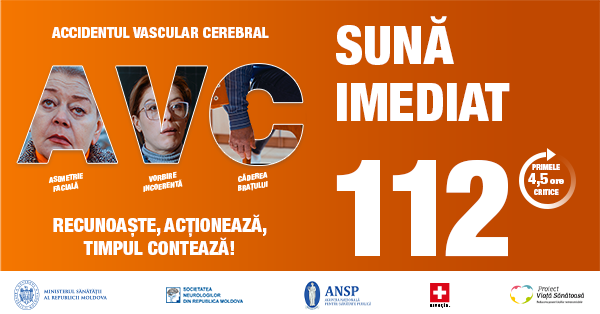
These results confirm the full functionality of the national stroke network and the real impact of the information campaign "Recognize! Act! Time counts!", which contributes to increasing the level of awareness and to the faster presentation of patients to the hospital.
The main signs of a stroke can be:
– asymmetry of the face (the mouth or the eye falls to one side);
– sudden weakness in an arm or a leg;
– difficulties in speaking or understanding speech.
Recognizing these signs and calling the Service immediately emergency 112 can save lives.
Admit it! Act! Time counts!
Most cases of stroke can be prevented by adopting a healthy lifestyle. For more information and materials of the campaign, go to The ACKNOWLEDGMENT Campaign! TAKE ACTION! TIME MATTER!